Case Study: 40°C Heat Stability Test for Gummy Supplements — Pectin vs Gelatin Performance During Middle East Shipping
The Problem: Gummies That Don't Survive the Journey
"We had a batch of gummies arrive at port — completely melted."
This is one of the most common complaints we hear from brands shipping to the Middle East.
The gummy market in the Middle East is growing fast. But there's a well‑known problem in the industry: gummies often deform, stick together, or even melt completely during shipping.
The reason is straightforward: gelatin gummies typically begin to soften and lose structural stability around body‑temperature ranges, depending on formulation composition and processing conditions. Factors such as Bloom strength, sugar solids, moisture content, and acid type all influence the actual behavior.
Shipping containers heading to the Middle East cross the equator. Under direct sunlight, interior temperatures regularly exceed 40°C — and in extreme cases, can reach over 50°C.
This isn't a quality control issue with any one factory. It's a material science problem.
We wanted to test something: Can we formulate a gummy that actually survives Middle East shipping conditions?
So we ran an internal test.
Our goal was simple: find out what works, what doesn't, and have real data to share with our clients. This article documents what we did and what we found.
What We Tested
We put two different gummy formulations through a 7‑day 40°C container simulation test:
| Sample | Description |
|---|---|
| Sample A | Standard gelatin‑based gummy (control) |
| Sample B | Reformulated pectin‑based gummy |
Test Conditions:
| Parameter | Setting |
|---|---|
| Temperature | 40°C (104°F) — equivalent to worst‑case Middle East shipping conditions |
| Duration | 7 days — simulating extended shipping plus potential port delays |
| Packaging | Standard retail bottles, packed in shipping cartons |
The Science Behind Gummy Stability
Why do gelatin gummies fail in heat?
Gelatin is a protein derived from animal collagen. It forms a gel through thermoreversible gelation — meaning the bonds that hold the gel together can be broken and reformed by temperature changes. When heated above its softening point (which varies based on formulation), gelatin gels break down. The gummy softens, loses shape, and becomes tacky — causing gummies to stick together in the bottle.
How does pectin differ?
Pectin is a plant‑based polysaccharide extracted from fruit. It forms a gel through a different mechanism. Pectin‑based gummies generally provide better heat resistance compared with traditional gelatin‑based gummies when formulation parameters are properly optimized. In practical terms, this means pectin‑based gummies can maintain structural integrity at significantly higher temperatures than gelatin‑based systems.
How does formulation affect stability?
The stability of pectin‑based gummies is influenced by several interdependent process parameters:
Temperature — affects gelation kinetics and the softening behavior of the final product
Water activity — influences microbial stability and shelf‑life
Sugar‑to‑acid ratio — determines gelation rate and final texture
pH — directly affects the charge state and cross‑linking capacity of pectin molecules
These four parameters are interconnected and must be systematically controlled during both formulation and production to achieve consistent results.
What about higher temperatures?
Industry data shows that by adjusting the pectin dosage, some optimized formulations may maintain improved structural stability at temperatures approaching 50°C, depending on formulation and packaging conditions. For Middle East shipping, we targeted performance well above 40°C to provide a safety margin.
Key point: Gummy supplements do not have a single fixed "melting point" like a pure substance. Instead, they exhibit a range of softening behavior that depends on formulation, processing, and environmental conditions. Heat stability testing helps determine suitable shipping conditions for your specific product.
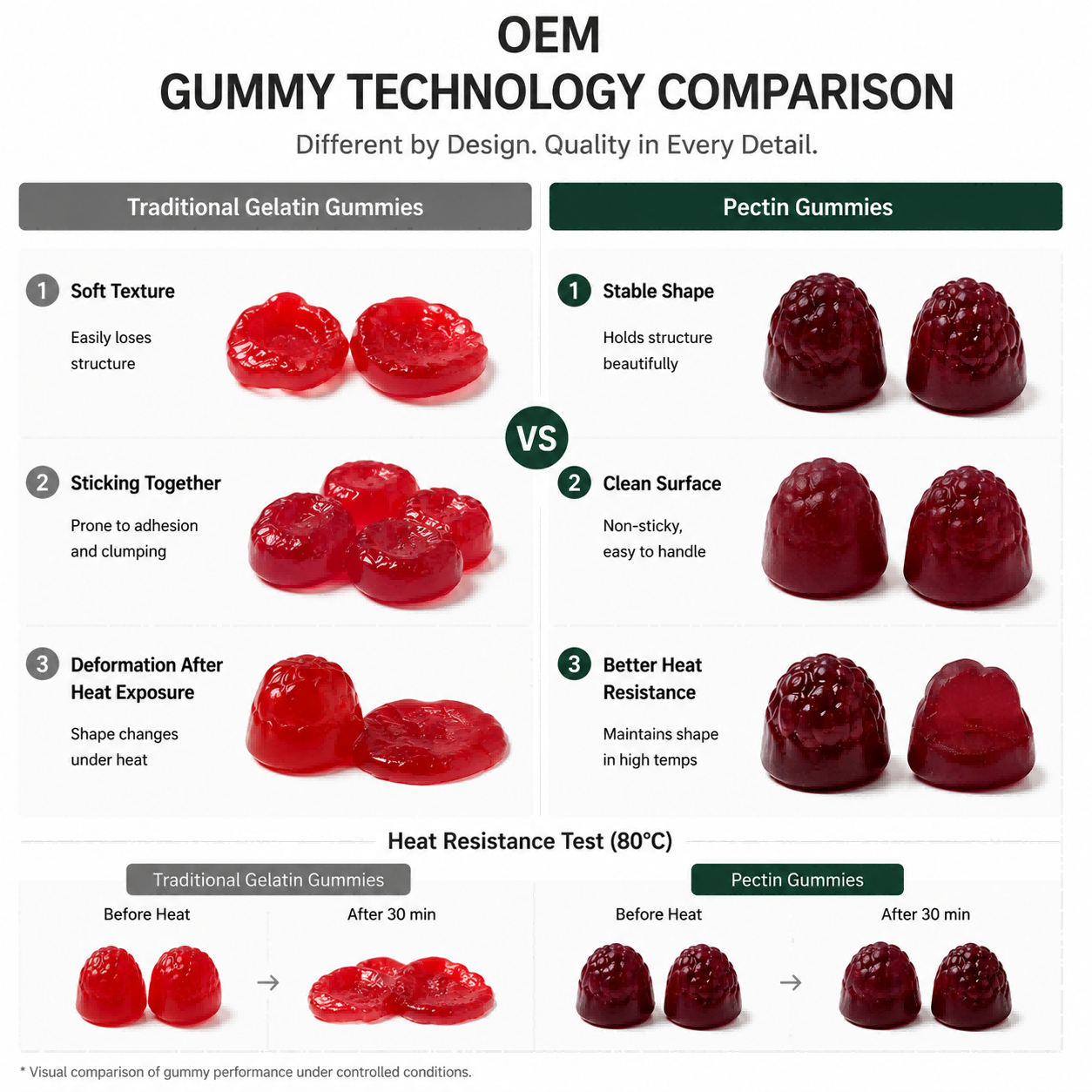
The Results
After 7 days at 40°C, here's how the two formulations compared:
| Parameter | Gelatin Gummies (Control) | Pectin Gummies (Test) |
|---|---|---|
| Shape Retention | Significant deformation | Minimal to no deformation |
| Sticking/Clumping | Severe sticking | No sticking |
| Surface Condition | Tacky, melted appearance | Dry, intact surface |
| Texture | Soft, lost structural integrity | Maintained firmness |
The gelatin gummies showed significant stability issues under the test conditions. They deformed and stuck together, losing their individual shape.
The pectin gummies showed significantly improved stability under the test conditions. They maintained their shape, texture, and appearance with minimal to no deformation — no sticking, no tacky surface.
Test Photos:
Photo 1: 40°C temperature simulation environment
Photo 2: Side‑by‑side comparison before testing (gelatin vs pectin)
Photo 3: Side‑by‑side comparison after 7 days at 40°C
Photo 4: Close‑up of pectin gummies after testing
Limitations of this test: These results represent our internal simulation test under defined conditions. Actual performance may vary depending on active ingredients, packaging materials, humidity, and transportation routes. We recommend conducting additional stability testing for your specific product formulation and shipping requirements.
What about 45°C? We've validated the pectin formulation at 40°C in a 7‑day simulation. Some optimized formulations may maintain improved structural stability at temperatures approaching 50°C, depending on formulation and packaging conditions. We can work with you to adjust the formulation if your shipping route requires higher temperature thresholds.
What This Means for Your Brand
If you're planning to launch gummy supplements in the Middle East, here's what our test shows:
1. Gelatin gummies may present stability challenges under 40°C shipping conditions. They deform, stick, and lose structure. Since Middle East shipping routes regularly exceed 35°C, gelatin is not a reliable choice for this market.
2. Pectin gummies offer a validated alternative under our test conditions. They maintain shape, texture, and appearance at 40°C. No sticking, no deformation.
3. The transition requires formulation expertise. Not all pectin gummies perform the same. Pectin type, dosage, pH, sugar‑acid balance, and processing parameters must be carefully optimized.
4. We have real test data to back this up. This isn't theory — we ran the test, we have the results, and we're sharing them transparently.
FAQ (Frequently Asked Questions)
Q: Are pectin gummies better than gelatin gummies for supplement brands in hot climates?
A: Pectin gummies generally provide better heat stability compared with traditional gelatin systems, especially when formulation parameters are optimized. In our 40°C test, pectin gummies maintained shape and texture while gelatin gummies showed significant deformation and sticking.
Q: What temperature can gummy supplements withstand during shipping?
A: It depends on formulation, packaging, and storage conditions. In our testing, optimized pectin formulations maintained stability at 40°C for 7 days. Some optimized formulations may maintain improved structural stability at temperatures approaching 50°C, depending on formulation and packaging conditions. Heat stability testing helps determine suitable shipping conditions for your specific product.
Q: Can you reformulate my existing gummy product for hot-climate shipping?
A: Yes. Our team can evaluate your current formulation and recommend adjustments — including pectin type, dosage, pH optimization, and processing parameters — to improve heat stability for Middle East or other hot-climate markets.
Q: How long does the reformulation and testing process take?
A: Timeline varies depending on your specific product requirements. Contact our team with your project details, and we'll provide a customized timeline.
Why Work with HHC‑Healthy?
At HHC‑Healthy, we've been manufacturing dietary supplements for over 20 years.
We know the unique challenges of shipping to hot‑climate markets. That's why we ran this test — to understand what actually works and what doesn't.
What we offer:
20+ years of manufacturing experience — we know supplements
Transparent test data — we share what we've learned from our internal tests
Expert formulation support — we'll help you select the right ingredients and optimize key parameters (pectin type, dosage, pH, sugar‑acid balance)
Private label and OEM manufacturing — from formulation to finished product
Honest advice — we'll tell you what we can do and what we can't
We believe in sharing our findings openly. The more you know about what works, the better decisions you can make for your brand.
Looking for a private label gummy supplement manufacturer for hot‑climate markets? Our team supports formulation development, heat stability evaluation, and finished product manufacturing — from concept to shelf.
For a complete COA report template or raw material test data related to the issues discussed above, please click "Contact Us" to request your free copy.
📧 Email:lisa@hhc-healthy.com
🌐 Website:www.hhc-healthy.com


